
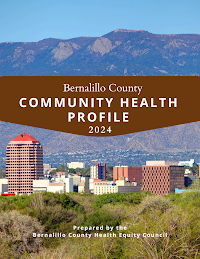
Report Type: Data Profile
BernCo Community Health Profile
YEAR
2024
AUTHOR / ORGANIZATION
Health Equity Council
GEOGRAPHIC SCOPE
Bernalillo County
What is this?
This is a community health profile—a comprehensive assessment document that systematically describes the health resources, needs, and characteristics of Bernalillo County's population. It was prepared by the Health Equity Council as the foundational document for developing the Community Health Improvement Plan for 2025. The methodology integrates data from multiple sources including the U.S. Census Bureau, New Mexico Department of Health, CDC, Behavioral Risk Factor Surveillance System (BRFSS), New Mexico Youth Risk and Resiliency Survey, County Health Rankings & Roadmaps, and FEMA National Risk Index. The report acknowledges data limitations including delays in reporting, sampling biases in surveys, gaps in social determinants data, and limited information on emerging health issues like substance abuse disorders and mental health conditions among vulnerable populations.
Summary
While this community health profile does not contain explicit behavioral health systems change recommendations, it provides critical baseline data for planning such initiatives in Bernalillo County. The report documents substantial behavioral health needs: drug overdose death rates of 39.5 per 100,000, 14.2% of adults reporting frequent mental distress, and 4.37 average mentally unhealthy days per month. Youth Risk and Resiliency Survey data reveal increasing rates of suicidal behaviors and mental health concerns among middle and high school students. The profile identifies significant health disparities affecting Hispanic (50.7% of population), Native American, and low-income communities that experience higher rates of chronic disease, poverty (14.2% overall, 22% among Hispanic residents), and limited healthcare access. Social determinants including poverty, food insecurity (12.8% of population), severe housing problems (18.2%), and educational disparities directly impact behavioral health outcomes. Systems planners should use this data to prioritize culturally appropriate services, address workforce needs in underserved areas, target prevention efforts toward youth populations showing increased mental health concerns, and ensure integrated approaches that address the interconnection between social determinants and behavioral health outcomes.
BH Systems Change Recommendations
**How This Report Informs Systems Change** This report does not contain explicit behavioral health systems change recommendations but provides essential data to inform such initiatives: 1. **Target Populations**: Data identifies Hispanic, Native American, and low-income residents as priority populations experiencing greatest disparities in behavioral health outcomes, requiring culturally appropriate and accessible services. 2. **Geographic Targeting**: Census tract-level analysis capability allows identification of neighborhoods with highest concentrations of risk factors for targeted intervention placement. 3. **Youth Prevention Focus**: Youth Risk Survey data showing increasing suicidal behaviors and mental health concerns among middle and high school students supports prioritizing school-based mental health services and prevention programs. 4. **Social Determinants Integration**: Strong correlations between poverty (14.2%), housing instability (18.2%), food insecurity (12.8%), and behavioral health outcomes support integrated approaches addressing social needs alongside clinical services. 5. **Workforce Planning**: Demographic data on language diversity (26.2% speak non-English at home) and cultural composition informs workforce development needs for bilingual and culturally competent providers. 6. **Crisis System Needs**: High violent crime rates (945 per 100,000), homicide rates, and substance-related deaths indicate need for robust crisis response infrastructure.
How to Use for Systems Planning
**What this report IS useful for:** - Establishing baseline metrics for measuring behavioral health systems change impact - Identifying priority populations and geographic areas for targeted interventions - Understanding social determinants affecting behavioral health outcomes - Informing culturally appropriate service design based on demographic composition - Supporting grant applications and funding requests with local data - Guiding workforce development planning based on population needs **What this report DOES NOT provide:** - Specific behavioral health systems change recommendations or action plans - Detailed inventory of existing behavioral health services and providers - Gap analysis comparing services to needs - Funding or resource allocation guidance - Implementation timelines or strategies - Evaluation frameworks for behavioral health initiatives
Key Facts & Data Points
- Population: 676,444 residents across 1,167 square miles (most populous county in New Mexico) - Poverty rate: 14.2% overall; 17% of children; 22% among Hispanic residents - Drug overdose deaths: 39.5 per 100,000 population (2022) - Frequent mental distress: 14.2% of adults reporting 14+ days poor mental health per month - Average mentally unhealthy days: 4.37 per month - Adult smoking rate: 14.8% - Excessive drinking: 15.6% of adults - Alcohol-impaired driving deaths: 25.4% of driving deaths - Food insecurity: 12.8% of population - Severe housing problems: 18.2% of population - Violent crime rate: 945 per 100,000 (increased 178 per 100,000 from 2014-2022) - Homicide rate: 10.2 per 100,000 - Premature death: 9,290 years of potential life lost per 100,000 - Median household income: $62,220 - Hispanic population: 50.7% (342,000 people) - Approximately 2,300 individuals experience homelessness annually
Priority Services & Findings
**SUD Organizations** - Drug overdose death rate of 39.5 per 100,000 indicates critical need for expanded SUD services - Excessive drinking rate of 15.6% among adults - 25.4% of driving deaths involve alcohol impairment - Opioid overdose rates higher than national average - Youth Risk Survey shows decreasing alcohol and drug use among youth but ongoing concerns remain **Mental Health / Crisis Care** - 14.2% of adults report frequent mental distress (14+ days/month) - 4.37 average mentally unhealthy days reported per month - Youth Risk Survey indicates increasing rates of suicidal behaviors among middle and high school students - Mental health characteristics worsening among youth populations - 18% of adults report frequent mental distress, higher among those in poverty - COVID-19 pandemic exacerbated existing mental health issues **Integrated Primary Care** - Chronic disease prevalence: 12% diabetes overall (21% Native American, 15% Hispanic) - Heart disease mortality: 155 per 100,000 (higher among African Americans and Hispanics) - Adult obesity: 28.6% - Physical inactivity: 23.4% of adults - Life expectancy disparities: 78.5 years overall; 77.2 Hispanic; 73.4 Native American **School-Based / Youth Services** - 17% of children live in poverty - Youth Risk Survey shows increasing obesity, suicidal behaviors, and mental health concerns - Sexual violence rates among youth higher in New Mexico than U.S. average - High rates of child abuse: data shows Bernalillo County among highest in state for food-insecure children - 65% of Bernalillo Public Schools students eligible for free/reduced price meals - 31.2% of students are English language learners
Immediate Actions for Systems Planners
-Cross-reference behavioral health service locations with census tracts showing highest poverty, food insecurity, and housing instability rates to identify service gaps. -Use Youth Risk Survey data on increasing suicidal behaviors to advocate for expanded school-based mental health services in Bernalillo Public Schools and Albuquerque Public Schools. -Develop outreach strategies targeting Hispanic and Native American populations who experience highest disparities in chronic disease, poverty, and health outcomes. -Incorporate housing and food insecurity screening into behavioral health intake processes given documented correlations with mental health outcomes. -Coordinate with the Health Equity Council's 2025 Community Health Improvement Plan development process to ensure behavioral health priorities are included. -Use drug overdose death data (39.5 per 100,000) to support expansion of harm reduction services and medication-assisted treatment capacity. -Analyze language data (26.2% non-English speakers) to assess need for bilingual behavioral health providers and interpretation services.
Key Contacts
**/ Health Equity Council = - Enrique Cardiel, MPH, Executive Director = - Deanna Thabatah, MPH, Lead Author = - Angelica Vazquez, MPH, Lead Author = - Rashid Ahmad, MPH, Lead Author = - Dan Herrera, Lead Editor **/ - NM Dept of Health = - NM Behavioral Health Collaborative = **/ - Albuquerque Public Schools = - NM Coalition to End Homelessness