
Report Type: Evaluation Provider Resource Toolkit
Sample Evaluation Form for Behavioral Health Service Division Funded Training
YEAR
2025
AUTHOR / ORGANIZATION
NM Health Care Authority, Behavioral Health Service Division
GEOGRAPHIC SCOPE
Statewide (New Mexico)
TOPIC AREA(S): Substance Use & Addiction Workforce & Clinical Training
What is this?
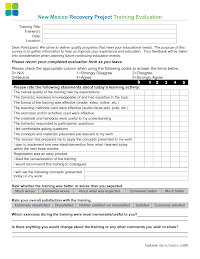
This is a participant evaluation form (survey instrument) used by the New Mexico Recovery Project to gather feedback on training sessions. The form uses a 5-point Likert scale (Strongly Disagree to Strongly Agree) plus open-ended questions. The methodology involves post-training self-report data collection measuring perceived training quality, trainer effectiveness, content applicability, and participant satisfaction. The form was last updated on June 11, 2020.
Summary
This evaluation form serves as a quality assurance mechanism for the New Mexico Recovery Project’s training programs. While the document contains no explicit systems change recommendations, it represents an essential component of behavioral health workforce development infrastructure. For Bernalillo County systems change efforts, this tool demonstrates a model for measuring training effectiveness and participant engagement in recovery-oriented practices. The form captures critical data points including trainer competency, content relevance to participants’ work, and—importantly—participants’ stated intention to implement new interventions within three months. This commitment-to-action metric is particularly valuable for tracking whether training investments translate to practice changes. Systems planners in Bernalillo County could adapt this evaluation framework to assess local workforce development initiatives, ensuring that training investments in SUD treatment, mental health services, and crisis care are producing measurable improvements in staff competency and service delivery quality.
BH Systems Change Recommendations
How This Report Informs Systems Change: This evaluation form provides a template for measuring workforce development effectiveness in behavioral health settings. Systems planners can use this model to: - Establish standardized metrics for training quality across behavioral health providers - Track participant commitment to implementing evidence-based practices - Gather qualitative feedback to improve training content and delivery - Demonstrate accountability for workforce development investments - Compare training effectiveness across different topics, trainers, and venues
How to Use for Systems Planning
**What this report IS useful for:** - Template for developing local training evaluation instruments - Model for measuring workforce development outcomes - Framework for quality improvement in continuing education programs **What this report DOES NOT provide:** - Actual training outcome data or results - Specific training curricula or content - Analysis of workforce development needs or gaps - Guidance on training topics or priorities
Key Facts & Data Points
- Uses 5-point Likert scale (0=N/A through 5=Strongly Agree) - Contains 14 quantitative rating items - Includes 2 overall satisfaction/expectation ratings - Contains 2 open-ended qualitative questions - Measures intent to implement new ideas within 3 months - Version 3, updated June 11, 2020
Priority Services & Findings
**SUD Organizations** The New Mexico Recovery Project focus suggests this evaluation supports training for substance use disorder and recovery-oriented service providers.
Immediate Actions for Systems Planners
-Review this evaluation template when developing local workforce training assessment tools -Adapt the "intent to implement" question for tracking practice change commitments in Bernalillo County training programs -Consider adding behavioral health-specific outcome questions relevant to local systems change priorities -Establish a system for aggregating and analyzing training evaluation data across providers
Key Contacts
**/- NM Recovery Project **/- SBS